AI vs human content writers: What to know before you make the switch for your marketing projects
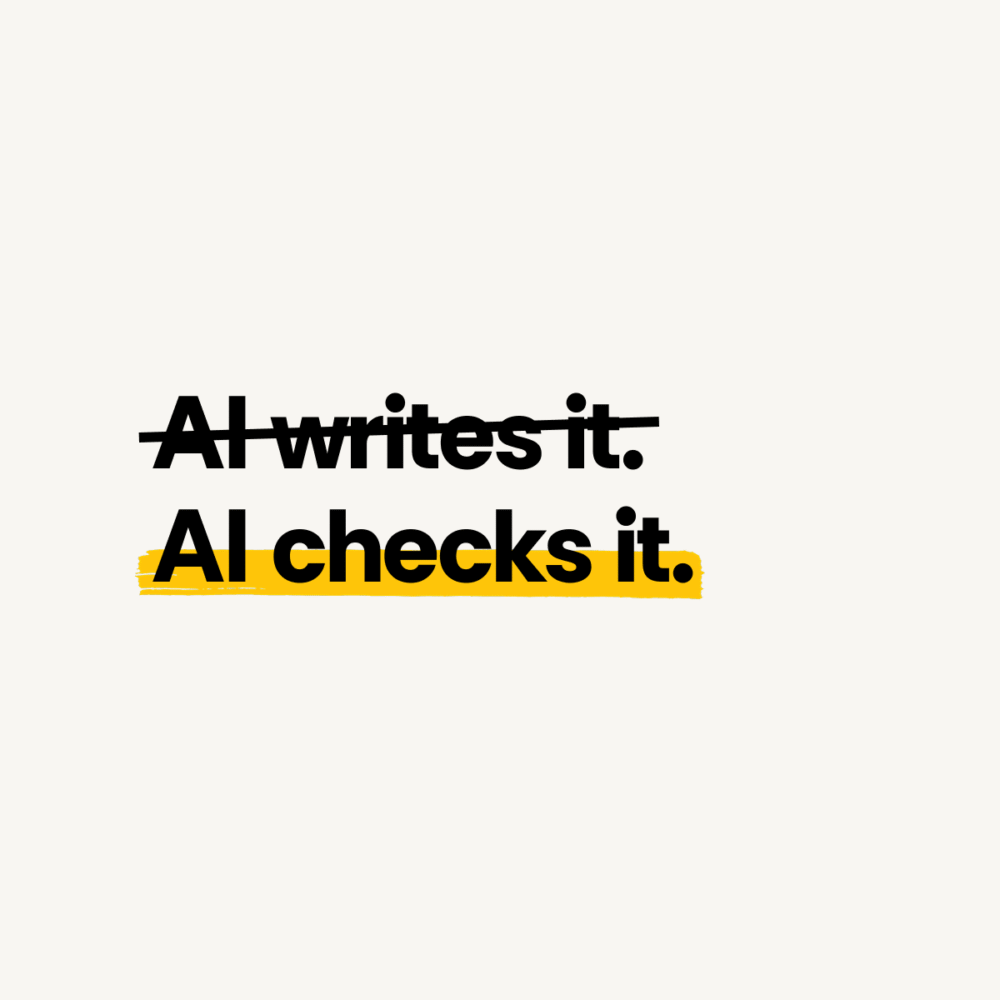
Thinking about replacing your writing team with an AI solution? Before you make a call on AI vs human content writers and editors, it helps to take a look at what current research says about AI-drafted marketing copy. There’s a lot to consider when weighing the pros and cons.
Currently, solutions like Claude and ChatGPT aren’t capable of producing perfect drafts of high-stakes marketing content. In fact, many find that the most surprising issue when using AI tools for writing is just how long it takes to fix their drafts—oof!
In a Templafy fall 2026 study of 2,000 knowledge workers, 95% said they have to edit AI output before it’s usable. On average, they report spending almost four hours a week doing this sort of cleanup work. Furthermore, a third of the people who spend over an hour on a document’s reworking said this type of editing can take longer than it would have to create the drafts themselves.
AI drafts also have the problem of sounding a lot like everyone else’s content—oof again! Two separate studies found that when people worked with AI, their output got more similar as a group, even when each individual piece got better.
Then there’s search—oof x2! According to Ahrefs, pages that are mostly AI-written can rank, but they’re a small share of the top results. In short, the more AI content a webpage has, the further down the results it typically lands. Plus, Anthropic and OpenAI recently updated their tools to auto-embed watermarks in copy their solutions produce. Unless you do significant rewriting, AI content from these tools can now be identified.
That said, not all is lost when it comes to being more productive with writing tasks by using AI. Keep reading to learn when it makes sense to accelerate your marketing output with options like Claude or ChatGPT and find out which tasks are best to use them for.
Where AI writing tools fit into a marketing writing project
The tasks below are the ones AI tools handle well right now. None of them involve writing the copy. They’re grouped by when they come up in a typical project, since the same tool ends up being useful for different things at different points.
Before the outline
Competitor gap check
If you haven’t done a check on your competition yet, AI solutions are a great way to do a check swiftly. Start by asking your tool to find the top-ranking webpages for the keyword you’re planning to target. Then, ask it to analyze what they’re covering and where there are gaps. (Those gaps are your opportunities!)
You can use all of these findings to put together a new post that actually adds something of value to your target audience, which gives you a stronger chance of ranking for this new asset. Be sure to also trust your instincts, though. AI can be wrong and miss things. If something seems off, dig deeper!
Research and source-gathering
When it comes to writing, AI options are also useful when it comes to doing initial research work. These tools can help you find the most relevant information on your topic. One caveat, though—make sure to ask for the links and check each to ensure all are still valid and really exist. Don’t put anything into your draft without vetting yourself.
Summarizing source material
If you need specifics from a muddy video interview transcript or jargon-filled 40-page industry report, AI solutions can be a godsend. Just attach or paste in the content you need analyzed and tell your tool what you’re looking for. It can help you pinpoint what’s in the asset that might fit the bill for your needs with the piece you’re writing, giving you more time to work on your actual composition and making it as persuasive as possible.
After the draft
Jargon and phase overuse
The only thing worse than too many cliches is too many instances of jargon in your copy. Once you have your first draft written, it’s a good idea to use AI to spot check your work for any banned terms that might have slipped into your prose. AI tools are helpful for spotting when no-no words and phrases show up (and they can also help you come up with alternatives, too, if any are found).
AI can also help you find redundant phrases. I have tendency of overusing “that said” in things that I write, so one specific way that I use AI tools is to find all the places where I’ve used this lazy transition in my writing so I can pull back and course correct as needed.
Voice and tone
ChatGPT and Claude are also really helpful when it comes to reviewing content for voice and tone mismatches. In short, the tools can make sure you’re adhering to all the basic mechanical rules (e.g., serial commas and heading case) outlined in your brand guidelines so that this cleanup work doesn’t require a second human review. That said, its helpfulness with voice and tone reviews can be hit or miss (often it depends on your instructions), so this step often still requires a human editor to read and review for the best results.
Weak-section
Worried you might be missing something? Trust AI for giving you feedback that helps you determine which sections in your piece are a little too thin. The tools currently available can be great at spotting things like claims without any support and instances where you’ve repeated yourself in the copy. You might find that you disagree with some of the feedback shared, but a weak-section check with AI can save you some time and at the very least give you a good starting point.
Readability
Ask for sentence length, passive voice percentage, grade level, and the five longest sentences in the draft. This is the same check a plugin like Yoast runs. Getting it done before the human read means that reader can focus on the things a plugin can’t catch.
During the edit
Visual ideas
Paste in a section that’s heavy on numbers or steps. Ask whether it would work better as a chart, a table, or a short list. Also, ask how you’d present the same information to a less technical reader, since AI tools turn out to be pretty good at spotting what’s hard to follow in running copy.
Backlink and interlinking ideas
Give it the draft and a list of your existing posts, then ask which ones to link to and from where. After that, ask what kinds of sites might link to this piece and why. Check every suggestion. The tool will sometimes name a post you don’t have.
Repurposing plan
Ask which sections could stand alone as a social post, an email, or a one-pager. What you want back is the list of ideas. The versions themselves should be written by a person.
Headline and subhead options
Stuck on what to name your piece? Looking for the best way to break up long prose? AI tools can be quite helpful in helping you come up with ideas for headline and subhead options. You may need to iterate a few times, but being able to quickly generate options with AI can really jumpstart your process of coming up with these pieces of your new asset.
Where the real savings come from
Swapping writers for an AI tool saves money on the draft and spends it again on the cleanup, and the research above says the cleanup is where the hours go. The savings that hold up come from the 12 tasks above. Research that used to take a morning takes an hour. The mechanical review happens before a person reads the draft, so the person reads it once. A writer who spends less time on prep and checks spends more time on the part only a writer can do. That’s the version of AI vs human content writers that works out, and it keeps the writers.
Frequently asked questions
What’s the best way to use AI for marketing writing?
Keep it out of the draft and put it to work before and after. Use it to check what’s already ranking, gather sources, summarize research, and then review the finished draft for jargon, weak sections, missing citations, and readability.
Does AI-generated content rank?
Sometimes. Ahrefs‘ 2026 study of a million top-10 pages found that pages with 80% or more AI content make up about 9% of top-three results, and the share of AI content rises the further down the first page you go. Mostly human pages are still the majority at the top.
Can anyone tell if content was drafted by AI vs human content writers?
Increasingly, yes. In fact, it’s why the term “AI slop” has gained in popularity. Anthropic now watermarks all Claude text output, and OpenAI watermarks ChatGPT output in the EU, with an API option elsewhere. Both companies say light editing leaves the mark in place. It takes doing a full rewrite to fully remove it.
Need a team that uses AI tools for writing the right way?
AI tools can save you real time on a marketing writing project, as long as the time goes toward research, review, and planning and the draft stays with a person. Skip that last part, and the hours you saved come back as cleanup, with copy that sounds like everyone else’s.
If you don’t have a writing team, or the one you have is stretched thin, the content strategy team at TBH Creative writes marketing content for clients across industries and uses AI for exactly the tasks in this post. We’d be glad to take a look at what’s on your plate.

About the author Joy Olivia Miller
Joy is the creative director at TBH Creative and uses her expertise to help clients use their online communications to build, design, and manage their brands. She likes to blog about content marketing in all its forms, the latest trends in digital marketing, and share tools with readers.