How to run an AI brand voice check that actually sticks to your guidelines

Ever tried using an AI-powered solution to check marketing content against your brand guidelines and not had much success? No matter what you’re starting with in terms of “rules,” here’s a rundown of how to complete an AI brand voice check that’s actually helpful.
Over the last 10 years at TBH Creative, I’ve drafted and edited everything from landing pages to blog posts for clients across a wide range of industries. Some have detailed brand books with nuanced tips for nailing voice. Others have just bare-bones mechanical phrasing requirements.
In this post, I’ll provide details on how to set things up so all the guidelines in your brand book are “translated” in a way that gives the model you’re working with something it can use to do a thorough check. Plus, keep reading to the end to learn what to do when your voice and tone must-haves are thin (or nonexistent) and which content prep tasks are best completed without AI’s help.
Start with your brand’s established writing rules
Many brand books present writing rules as a short “editorial style” page or a brief bullet list of tips. Mechanical rules are the easiest ones for a model to follow and the easiest ones to check.
Details about voice and tone are the most frequently overlooked, so these guidelines may be the ones you’ll need to prepare separately. These might include whether your copy should always be written in active voice over passive as well as details about the words you never use (e.g., no use of jargon, clichés, a competitor’s terms) and preferred terms for actions, like “we always use log in instead of sign in,” for example.
Also, you’ll want to be sure to look for a reference to your company’s preferred style manual—such as the Chicago Manual of Style, APA, AP, etc.—and notes on deviations or exceptions (more on those below).
Whether you’re pulling these from your brand guidelines or preparing them for the first time, here are the basics you’ll want in place to get the best results from an AI brand voice check.
Capitalization
Capitalization rules should cover things such as whether you use title case or sentence case for headings, which product and feature names are always capitalized, and whether job titles get capitals in running text.
Punctuation
The serial comma is the single most-checked rule I see (and it’s also the thing that most companies have a strong opinion about), so make sure this is logged. Then, it’s also helpful to spell out your rules for the usage of hyphens, en dashes, and em dashes, including whether there are spaces around them.
Numbers and dates
Write up your rules for when numbers are presented as words versus when they’re used as numerals and also make sure to specify how you write dates and times as well as whether it’s “5%” or “5 percent.”
Abbreviations
Include in your basic rules whether acronyms get spelled out on first mention. And, if there are any exceptions to this rule, document the approved ones as a list so it’s clear.
Rules for regulated industries
If you’re in healthcare, insurance, or another regulated space, your brand book probably already has some of the most useful rules in it. They are probably things like “never promise a specific outcome” and “always include this ABC disclosure when you mention XYZ.” Rules like these are easy for a model to check because they’re hyper-specific (and AI loves when you aren’t ambiguous), so make sure to pull everything like this into your writing rules.
That said, if you work in a regulated industry, you’ll need to do more than an AI brand voice check before calling any copy you produce done. You still need to allow time in your schedule for a final review (and sign-off) by your compliance officers or legal team. And, it probably goes without saying, but remember to never share patient or customer data with an AI tool.
Additional exceptions
Don’t forget about the exceptions that don’t fit neatly into typical style rules. For example, when I worked at the University of Chicago, the school’s full name was preferred on first reference with “the University” or “UChicago” okayed for subsequent uses. That said, “U of C” as a variation was almost always not okay unless, for example, an alum said “U of C” in a quote because we wouldn’t edit their words.
If your company or organization has any outliers, don’t forget to write those up and add a line or two into the brand writing rules for your AI tool to reference.
How to prep useful voice and tone rules when they’re missing from your brand book
The best way to get good results from an AI brand voice check is to provide your tool of choice with voice and tone guidelines along with mechanical rules. So, if you don’t have these guidelines, the ideal alternative is to provide it with examples of your top content.
Go through your recent deliverables, and pull pieces that sound just right to you in terms of voice and tone. Good sources of samples include popular blog posts, high-converting landing pages, viral social posts, detailed case studies, and sometimes even robust service detail webpages. Five solid assets are enough to start.
Ask your AI tool to read each one and describe your company’s brand voice by what these examples all have in common. Request that it focus on factors like sentence length (and variety), level of formality, use of “you,” inclusion of questions, frequently reused talking points and phrases, and where the tone changes from one type of content to another.
You’re not done just yet! This is only the first step because you’ll likely get a description back that’s only partially right. Next, it’s time for you to review what your AI tool sends, correcting anything that sounds off and adding the stuff that you know about your brand that perhaps wasn’t made clear in the samples you shared.
This refined write-up will become your final voice and tone section when running an AI brand voice check.
How to run an AI brand voice check
First things first—give your rules a home in your tool of choice. Most will let you save instructions and files that carry over into every conversation (e.g., a project in Claude or ChatGPT). This will save you the headache of pasting the same guidelines in every time you have something you want to run through an AI brand voice check.
What to include in the request
Because you’ve done all this work upfront, your request can stay pithy.
When you’re ready to do a review, paste in the draft you want feedback on. When sharing this copy, make sure to say what kind of content it is. This is helpful since a blog post needs to read differently than a landing page or social media post. Then, ask your AI tool for a review against the rules.
Here’s what my prompt usually looks like:
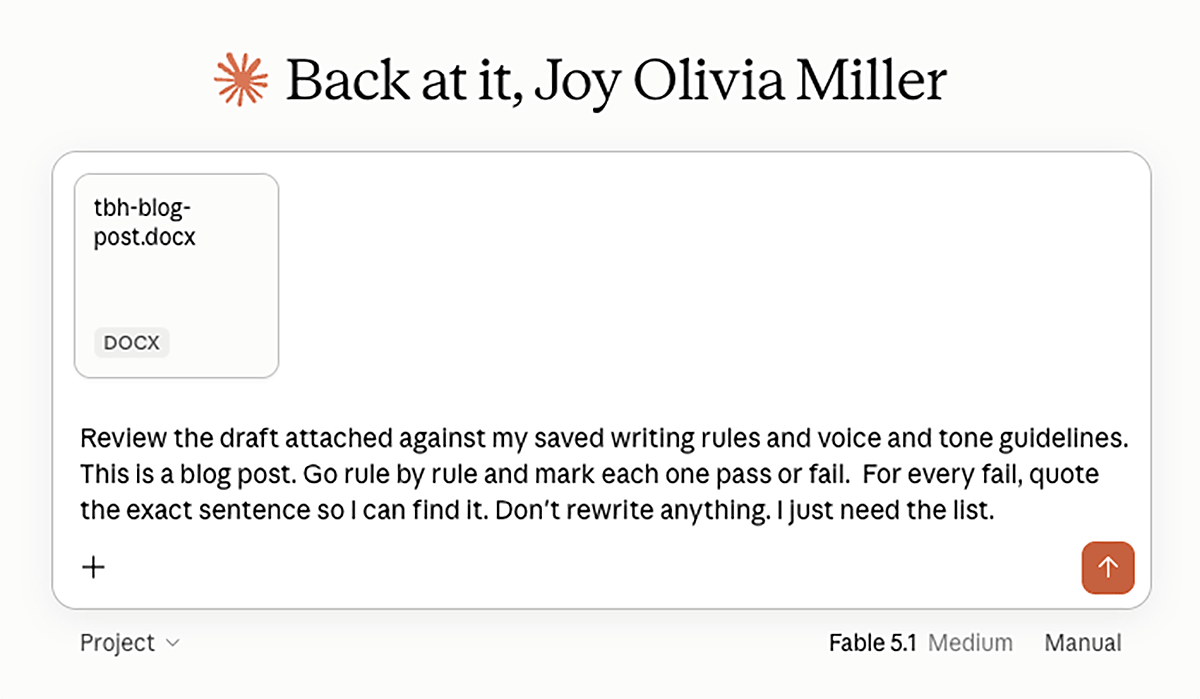
Note: I always include that last part to avoid having Claude waste tokens on putting together a revised draft.
What you can expect a check to actually cover
Claude and ChatGPT are nearly unmatched when it comes to checking content against mechanical rules. That said, at the present, professional editors are often better at ensuring a piece of content matches the right voice and tone. So, at a minimum, your preferred AI tool will help you save time by flagging issues like missing serial commas or heading case issues, freeing up your human reviewers to focus on optimizing the text to ensure it sounds on brand.
Ready to complete your first AI brand voice check?
Start with the rules you already have, add a voice and tone section built from your best content, and give your tool a short, specific request. That’s enough to get a useful AI brand voice check on the next draft that lands on your desk. Writing the draft itself is a different story, and I’ll cover why that still belongs with a person in an upcoming post.
Frequently asked questions
Can an AI tool check content against my brand guidelines?
Yes, as long as the guidelines are written as specific rules the tool can look for. Mechanical rules like serial comma use and heading case work best. Adjectives like “friendly” don’t, so you’ll want examples of your content to go with them.
How long should a brand voice section be for AI?
Shorter than you’d think. A page of rules with an example for each, plus five sample pieces, is enough to start.
Does an AI brand voice check replace an editor?
No. The tool is reliable for mechanical rules. A person still does the read for word choice and overall voice, and for regulated industries, compliance or legal still signs off.
Need help getting your brand guidelines in shape?
If your brand book is thin on writing rules, or you’d like a second set of eyes on content before it goes live, the content strategy team at TBH Creative can help. Let’s talk about what you’re working on.

About the author Joy Olivia Miller
Joy is the creative director at TBH Creative and uses her expertise to help clients use their online communications to build, design, and manage their brands. She likes to blog about content marketing in all its forms, the latest trends in digital marketing, and share tools with readers.