Healthcare guerrilla marketing: Inspired ways to turn leads into patients
If you are searching for a unique, creative, and unconventional way to make your hospital or doctor’s office stand out and be noticed, healthcare guerrilla marketing might be your answer.
We live in a world where healthcare systems compete for patients, technology is ingrained in our culture, and marketing efforts are tired and overused. To reach consumers—who know they have a range of healthcare options to choose from—hospitals and doctors’ offices need to adopt a different approach to healthcare marketing.
Read on to learn why we think healthcare guerrilla marketing is worth considering.
What is healthcare guerrilla marketing? What’s the point of it?
Guerrilla marketing in healthcare is a bold way to grab your audience’s attention in a memorable, unexpected way. Using humor, surprise, and creativity can inspire an emotional connection between your hospital and your audience.
Healthcare guerrilla marketing can not only be effective but also inexpensive. While you may need to invest more brain power to think outside the box and get the creative juices flowing, using guerrilla marketing to promote your healthcare organization won’t make a big dent in your bottom line.
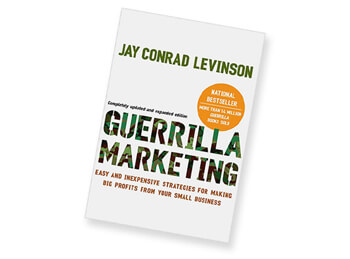
The term “guerrilla marketing” was coined in 1984 by Jay Conrad, author of Guerrilla Marketing. His book was named Time’s top 25 most influential business management books and is considered one of the leading marketing books ever written.
Types of healthcare guerrilla marketing
If you are wondering how you can apply guerrilla healthcare marketing tactics to your marketing plan, here are a few guerrilla marketing subcategories you could consider:
- Buzz
- Event ambush
- Experiential
- Grassroots
- Omnichannel
- Stealth
- Street
Buzz
True to its name, the purpose of buzz guerrilla marketing is to generate hype and conversation about a healthcare organization.
It spreads among potential patients, creating positive excitement about your services and treatments.
People are more likely to trust a new provider if someone they know has seen them and has spoken positively about the care they received.
An example of this type of healthcare guerrilla marketing is when hospitals gave consumers an “I Got My COVID-19 Vaccine” sticker after they received the vaccine.
Facebook and Instagram encouraged people to share a sticker on their stories or feeds to prompt action from others and create FOMO (fear of missing out).
Event ambush
Event ambush healthcare guerrilla marketing is when you use a live event to promote a treatment or service in a way that gains attention. It usually occurs during newsworthy events, such as elections, the Olympics, championship games, big concerts, etc.
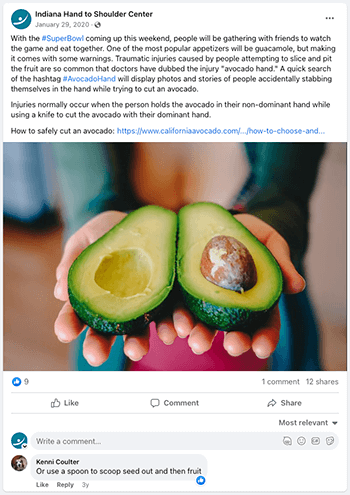
Here’s a specific example: Cutting avocados for guacamole for Super Bowl party prep has led to many knife injuries and mishaps, spiking visits to the emergency room.
As an event-ambush tactic, orthopedic practices can hijack popular Super Bowl hashtags associated with the NFL and deep-pocket advertisers to share tips for safely carving avocados and to promote injury care services.
This social media hashtag-based event ambush tactic can be repeated when it makes sense (e.g., on Halloween (pumpkin-carving), Thanksgiving (turkey-carving), the 4th of July (watermelon-carving), etc.).
Experiential
Experiential guerrilla marketing is a strategy that uses in-person experiences to build loyalty and trust with your brand before they need you.
This try-before-you-buy approach allows consumers to feel, touch, and see your product and what it can do for them before they make a purchase.
Membership warehouses, such as Costco and Sam’s Club, place “freeosks” and brand-ambassador-run carts throughout the store to offer samples.
While checking out items (from mixed nuts to hand sanitizer), customers get information on the value, cost, and location of the promoted products.
Grassroots
Grassroots healthcare guerrilla marketing starts by building a following from the ground up. Instead of appealing to a large group, you target your messaging to a smaller group of followers, hoping they will spread your message to a larger audience.
Social media influencers, brand ambassadors, and targeted Facebook groups are great examples of grassroots marketing.
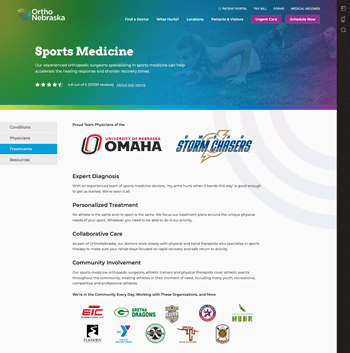
Influencer marketing can be very effective because these influencers have audiences that meet your target criteria and align with your brand.
For example, some healthcare clients provide services to local professional and amateur athletic teams. These hospitals and orthopedic practices promote their connections with influential patients by including team logos on their sports medicine service pages and by publishing patient stories about the care their specialists provide.
Stealth
Stealth healthcare guerrilla marketing is advertising your product to your consumers without their knowledge. You can accomplish this with careful product placement or with brand ambassadors who post about a product or service in a natural, non-advertisement way.
A hearing loss practice that wants to encourage people to get their hearing checked may use bumper ads before ASMR YouTube videos.
These short, memorable, bite-sized videos are designed to increase awareness of a product or service with brief messages. They keep the audience’s attention because they are not skippable and feature a countdown timer showing how long the ad will last.
Street
Street marketing brings a brand’s product or service directly to the consumer in a public place they often frequent. It attracts attention, makes an impression on the brand’s target audience, and creates a memorable, unique experience.
4 examples of healthcare guerrilla marketing worth stealing for your hospital or practice
If you’re struggling to come up with a strategy for healthcare guerrilla marketing, here are a few ideas you could adapt to promote your providers and services:
Oral-B
By painting its logo on cracked, neglected sidewalks, Oral-B used healthcare guerrilla marketing tactics to remind people why taking care of their teeth is so important.
Dental practices can adopt a similar method, using chalked stencils of their logo near cracks and potholes around town to promote oral health and their services to help people get (and maintain) the smiles they love.
CVS
Over the last few years, CVS has installed temporary outdoor yard signs and streetlamp posters near its pharmacy locations offering free flu shots.
Hospitals could follow the chain store’s lead and mount signage on street lights and light posts to promote their seasonal offerings, such as flu shots, COVID boosters, annual physicals, blood pressure checks, and other essential services.
Pearle Vision
Pearle Vision promoted its eye doctors’ services with a funny eye-test billboard featuring a punch line only people with good eyesight could see.
The words “never mind” in tiny type lay below the larger message, which was much easier to read: “Get Our Free Eye Test.”
Optometrists and ophthalmologists could use a similar healthcare guerrilla marketing approach with a different tiny-type message, like “you’re good for another year.”
Fitness World
Fitness World placed stickers on entrance stairways to mimic step aerobics and promote its workout classes.
A hospital’s weight-loss program could use this healthcare guerrilla marketing strategy.
In their version, their marketing teams could use steps to subtly remind patients that they offer diet and exercise support that could help them improve their health “one step at a time.”
More ideas to jumpstart your campaign planning
Many marketers have found that street marketing is the easiest and often most affordable healthcare guerrilla marketing strategy.
Temporary chalk street stencils and floor stickers are a great way to promote your healthcare organization or hospital, especially in areas with high foot traffic. If your campaign is done well, you’ll get those people who are looking down to look you up.
Orthopedics
If your multi-site orthopedic practice is a sponsor of a large sports park complex, why not get permission to chalk a hopscotch board on the sidewalks near the playing fields during the next big tournament weekend?
Complete each hopscotch layout with a stencil of your practice’s logo. Pair them both with a short plug to inform passersby that your urgent care services are only a “hop-skip-and-jump” away or that your specialists are ready to help injured athletes “bounce back” into the game.
Podiatry
If you are a podiatrist, why not chalk footprints along the path of the next 5K or half-marathon scheduled in your town as part of a healthcare guerrilla marketing campaign?
Design your campaign so that all the chalk stencil footprints lead to a concluding offer, such as a free running gait analysis for any runner who makes an appointment at your podiatry office and brings in their race bib.
FAQs about guerrilla marketing healthcare
Do you have a question about healthcare guerrilla marketing? Check out the answers to some of the most frequently asked questions by healthcare marketers like you.
What are the disadvantages of guerrilla marketing in healthcare?
While guerrilla marketing can be effective, it takes time to see results. There won’t be a line of patients at your door the next day.
Like most marketing tactics, it takes consistent, steady exposure over time for your audience to develop trust with your hospital or healthcare system.
Is guerrilla marketing part of digital marketing?
Healthcare guerrilla marketing and digital marketing are different approaches, but they overlap and work well together.
Healthcare digital marketing uses online channels to promote a brand through content marketing, search engine optimization, social media marketing, and others. Guerrilla marketing takes consumers by surprise, making a solid impression and creating social buzz, and sometimes uses digital channels to do it.
Both approaches use influencer marketing, social media, and other digital avenues to reach their audiences.
Who created guerrilla marketing?
As mentioned earlier, the term “guerrilla marketing” was coined by Jay Conrad Levinson in his 1984 book of the same name.
His book suggested that campaigns must be outrageous, clever, and unique to stand apart from the competition. He identified unconventional approaches to the tired, traditional forms of advertising that were no longer resonating with audiences.
Need help with your guerrilla healthcare marketing?
If you are interested in learning more about healthcare guerrilla marketing and how to use it in your hospital or doctor’s office, TBH Creative can help. We love working with healthcare organizations to brainstorm unique, creative, and effective guerrilla marketing strategies to make you stand out.
About the author Tatum Hindman
Tatum is the president of TBH Creative and is responsible for building long-term client relationships. She enjoys the strategy behind web design and collaborating with clients to define and execute online marketing goals. She likes to blog about hot topics in web design and digital marketing, as well as share tips for strengthening your online presence.